“You’ve got to spread love and happiness”: How Barry Hearn transformed darts into a global phenomenon

Barry Hearn in 2012, known for his transformative influence on sports like snooker, darts, and boxing.
Credit: Image by Matt Fowler, CC BY-SA 3.0, via Wikimedia Commons. Link.

Raucous fans, fancy dress, packed arenas. A sport once tied to local pubs is now prime time, global entertainment. And behind it all is Barry Hearn, the larger-than-life promoter whose Midas touch elevated darts from smoky boozers to the Ally Pally stage. This is how he did it.

Through his company, Matchroom Sport, Hearn has become one of the most influential figures in darts, eventually serving as chairman of the Professional Darts Corporation (PDC) until 2021. Reflecting on his journey on his podcast ‘The Barry Hearn Show’, Hearn shared how he transformed darts from pub entertainment to a global spectacle.

In the early 1990s, the British Darts Organisation (BDO) was struggling, and in a transitional phase for the sport, the PDC broke away, determined to carve out its own path. They approached Hearn, already a successful promoter of snooker, boxing, and football, hoping he could work his magic on darts.

“You never know when an opportunity is going to slap you in the face, and the good Lord smiles,” Hearn jokes.

He recalls meeting trailblazing figures who were passionate about darts, with a vision of where it should be and frustration that it wasn’t there yet. It was at The Circus Tavern, a local venue in Essex, where Hearn saw the potential of darts and was immediately hooked.

“You couldn’t see across the room for smoke,” Hearn recalls. 

“There were bookmakers in the corner, people betting on 180s, who’d hit a 170 checkout, the big fish. They were having a few beers and chanting with their mates. 

“But in front of them, through all this atmosphere, was world-class sport. And I thought, if I wanted a night out, I’d come here.”

For Hearn, it was more than a business opportunity; darts was a passion project. He was drawn to the people, the stories, and the atmosphere surrounding the sport.

“I could see in darts, even back then, I liked the customers,” he adds. 

“They were ordinary people from where I came from, just wanting a good night out. Nothing complicated.”

That sentiment holds true today, with the fan culture and atmosphere preserved as darts has ascended to the big leagues.For darts to have its current reputation, Hearn also credits the players and their personalities, whose charisma contributes to the sport’s excitement.

He hilariously recalls the late Jocky Wilson, a darts legend, dampening fellow pro Rod Harrington’s party piece of catching a dart mid-flight by stabbing him in the belly with another dart.

“Jocky was on the floor in hysterics, and Rod was just looking at his shirt as a trickle of blood rolled down. No lasting damage, but that was darts,” Hearn laughs.

Darts, however, isn’t about practical jokes. Behind it are players who want to win, but these individuals, who honed their skills in pubs and clubs, knew they had to entertain.

“In working men’s clubs, you had to be interesting, or people wouldn’t come to watch,” Hearn says. 

“You needed a quick line, a shout-back, an answer.”

Perhaps none did this better than the ‘Crafty Cockney’ Eric Bristow. Around Bristow, Hearn built the characters that now captivate darts fans.

“He had persona. He had charisma, and he didn’t give a monkeys. Fans would throw beer cans at him, and he thought it was hilarious, knowing he’d got to them.”

“When you put together great shows, you’re a ringmaster. You need an angle, you’re selling tickets, you’re trying to get ratings, you want headlines and people talking about it,” Hearn explains. 

“You need those characters because they’re priceless.”

With TV in mind, Hearn knew that while darts had a marketable raw product, it needed exposure. When Sky offered a deal, the ratings rocketed. TV brought quirks like fancy dress and signs, giving everyone their moment of fame. Hearn recalls a fan, famous for dressing as a chicken, calling him for a ticket.

“I said, ‘I’ve got a geezer on the phone saying he’s the chicken,’ and the team said, ‘oh, the chicken hasn’t got a ticket? We’ll get him in.’ He was the first I remember in full costume.”

The atmosphere became as much a part of the darts experience as the matches themselves. Fans weren’t just spectators, they were part of the show, whether through wild costumes, signs, or chants. Hearn understood that this sense of inclusion, where everyone had a role in the spectacle, was key to building a loyal following and an experience people wanted to come back to.

“You’ve got to spread love and happiness,” Hearn adds. “When people go to the darts, they have a great time and tell their mates the next day and this is the ultimate marketing tool.”

The potential Hearn saw has been fulfilled and more, with the 2024 World Champs Finals between Luke Humphries and Luke Littler attracting the highest ever non-football audience on Sky Sports at 4.8 million.

With Sky’s backing, Hearn’s ambitions took darts global. Packed arenas across Europe and even Madison Square Gardens in New York now sells out in minutes.

“Madison Square Gardens sold out for darts, with 70% of the crowd in fancy dress. Where did that come from?” Hearn says.

Hearn’s success isn’t waning, with demand driving tours in countries like Poland, Australia, and the Middle East.

“Whether it’s New York or Auckland, they can’t get enough. Broadcasters are coming in, paying more,” Hearn says.

With increasing revenue, Hearn views this as a chance to improve competitiveness and the sport’s quality.

“You’ve got to give kids a chance. If they can earn money, they’ll put in more hours, make sacrifices, and the snowball starts,” he says.

He’s delighted that players from humble, working-class backgrounds can benefit. 

“I remember Nathan Aspinall, he got to the semi-finals, and he won £100,000. He said, ‘my house cost me 30 grand! It’s the most unbelievable day I’ve ever had.’”

With money and TV deals, Hearn believes darts will only improve for players. “Soon, they won’t just be millionaires, they’ll be multi-millionaires.”

Hearn’s commitment extends to the sport’s future through youth programs like the Junior Darts Corporation (JDC). Rising star Luke Littler, who joined the JDC at 10, is already making a significant impact, captivating audiences and redefining the sport for a new generation.

“He could be one of the greats, and that’s the sacrifice he has to make,” Hearn says. “He hit a nine-darter in his first match after the World Championship. We’re being entertained by greatness.”

Littler’s presence on the darts scene has been pivotal in attracting a younger audience to the sport. Littler connects with fans who might not have seen themselves in darts before. This younger fan base is invaluable, bringing fresh energy and ensuring the sport’s longevity in the newest chapter of the sports rapid rise. 

As darts continues to evolve,  Hearn’s influence is evident in every aspect of the sport. His relentless drive to elevate darts has created a thriving community which we as fans are the beneficiaries of. 

Reflecting on his journey, Hearn is proud of his legacy. “In my own way, I’m building something for when I’m gone. I’d like darts players in 50 years to raise a glass to me. Is that big-headed? I don’t care. I know I’m doing a good job.”

To any doubters, his message is clear: “All those snobs, looking down their noses—fat blokes, pot bellies, smoking, drinking, darts? Look at them now. They’re the ones phoning me up, begging for a ticket. And I love it.”
East London Gymnastics Centre that has trained Olympians faces closure

The East London Gymnastics Centre (ELGC) is facing closure due to housing development plans, putting the future of elite and community gymnastics at risk.

Since freeholders sold the site to housing development group Galliard Homes, ELGC managers Alex Jerrom and Kirk Zammit fear they will be replaced by tenants who can afford higher rates.

They have launched a petition as they look to secure the future of the gym which has trained some of the top gymnasts in the country, including Paris 2024 athlete Georgia Mae Fenton.

The fate of the ELGC has come under threat after the site it is on was bought by Galliard Homes.

Once a deal was made, ELGC was assured they could negotiate their tenancy with the new owners.

Jerrom said: “They simply replied that the redevelopment was no longer viable, and that was it.

“Later, they called to say they would keep the site for leisure, but we wondered why we hadn’t received an offer to stay.”

In response, Galliard Homes claimed to be committed to retaining the building and ensuring its financial viability.

They said: “We have secured a new tenant who will bring significant health and social benefits to the community.”

Despite Zammit and Jerrom’s concerns about poor communication, Galliard Homes disputes their claims.

Galliard Homes added: “Since agreeing to purchase the site, we have kept existing tenants informed of our plans, including the decision not to move forward with a residential-led development.”

Opened in 1998 with National Lottery Funding, ELGC in Beckton has long been a cornerstone of the gymnastics community.

Jerrom and Zammit have operated the club as a non-profit charity since 2015 and take pride in its contributions to elite gymnastics.

Zammit said: “There is so much history at this club, even before this place was built, we’ve had multiple British champions and GB team members competing at Worlds and Euros.”

Zammit described the club as a hub of London regional gymnastics. 

He said: “We currently have two girls on the GB team and another on the Polish national team.

“Next year, we are likely to have three more girls join the GB team, more than anyone else in Greater London.

“Without this facility, future Olympians won’t have anywhere to train.”

Beyond gymnastics, the centre impacts the broader community by supporting various groups and businesses, including a circus school.

Despite the progress of the ELGC, the prospect of closure is becoming increasingly likely.

Jerrom said: “There’s no other facility that’s affordable and large enough for us to move into, so we will be forced to close the club down.”

They worry that in a low-income area like Newham, the changes brought by developers are part of a trend of closures.

Zammit added: “In Newham, there used to be four leisure centres, but two are closed, and one is soon to close.

“Soon, there will be one leisure centre in the entire borough.”

Many similar spaces have already been lost, including The Hub, a vital dance space, Overgravity, a tricking gym in Bow, and Parkour Generations Chainstore, significantly impacting arts and sports communities.

There are also concerns that new tenants will not maintain the community impact of ELGC, with fears that developers will favour economic gains over engagement.

Jerrom said: “They’re likely to bring in something like a fitness gym or a bowling alley.

“Leisure is such a broad category that it won’t be a community centre or hub, and it won’t foster social interactions.

“The friendships and lifelong connections built here are invaluable.”

Beyond elite sports, the gym serves as a sanctuary for community members who benefit from its positive impact on well-being.

Zammit added: “Many people come here for help with their mental health, social anxiety, and self-confidence.”

This motivation drove Zammit to take over the East London Gymnastics Centre.

He reflected: “My life would have been completely different without sport giving me focus.

“I grew up in a rough area of East London, and the old East London club was where I first trained.

“I know what these kids are putting into their sport, and they need support.

“When my Mum couldn’t afford to get me to the gym, people made sure I could continue training because of their passion for the sport, and that’s why this is so important.”

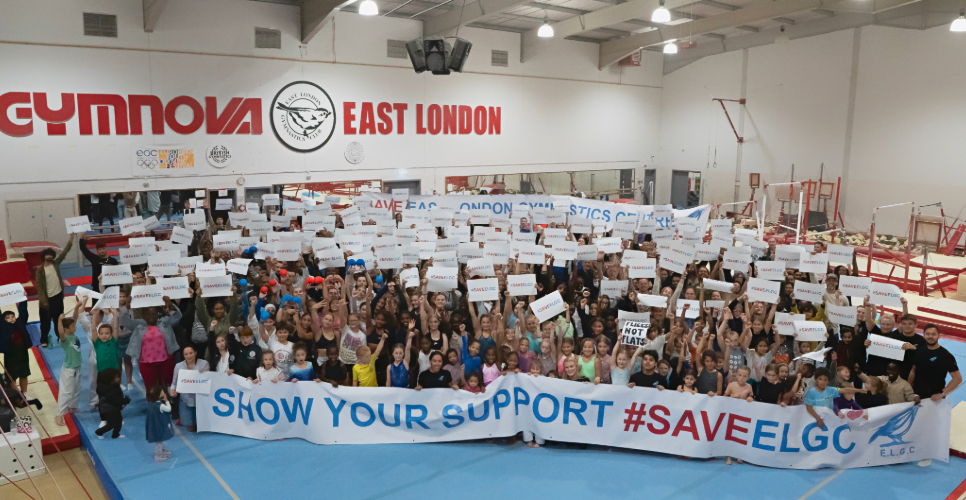
Determined to fight the closure, Zammit and Jerrom have launched the SAVE ELGC Campaign.

James Asser, MP for West Ham & Beckton said: “I am truly saddened to hear of the risk of closure faced by ELGC.

“Having visited the facility I can see that it is an invaluable asset for not only those in the Beckton community, but for everyone who is passionate about elite sport across London and nationally, having trained some of our Team GB athletes.

“Losing such a resource would be a tragedy for the individuals who train at and are supported by the centre, and I will work with all those involved to insure it remains as an invaluable part of my community.”

Featured image provided by ELGC – permission to use

Corner shop investment reaches record high as independent owners dominate

This article has been published by the North East Londoner and can be accessed here: https://www.nelondoner.co.uk/news/24092024-corner-shop-investment-reaches-record-high-as-independent-owners-dominate

Investment in corner shops reached £1 billion over the last year with independent vendors still dominating despite supermarket expansion, latest data shows.

The Association of Convenience Stores (ACS) 2024 Local Shop Report found that investment is the highest on record since the report’s inception in 2012.

Much of this growth comes from chain supermarkets aiming to tighten their grip on the local community shopping market, but 71% of convenience stores in the UK are still owned by independent retailers.

In August, Waitrose announced plans for 100 more convenience stores whilst Morrisons are targeting a further 400 by 2025, creating stiff competition for independent shop owners.

Mehmet, 46, owner of VitaPure in Bethnal Green, said: “Big chains, they hold everything. 

“Morrisons, Co-op, they make deals which mean I will only get three cases, and they’re gonna get a pallet, so they can sell cheaper.”

VitaPure, Bethnal Green. Credit: Harry Crichton

Sahin, 40, owner of Greenwood Food & Wine in London Fields said: “I know friends who lost half of their business after a Tesco Express or Sainsbury’s Local opened nearby. 

“Some of them even shut their shops.”

Rising costs of groceries and inflationary pressures compound the challenge corner shop owners face in this newly competitive market, giving a clear advantage to chain convenience stores who can afford to buy in bulk and sell at cheaper prices.

Sahin said: “If I bought six tonnes of olive oil two years ago and kept it, I’d be a millionaire now.”

However, contrary to long-held predictions of their decline by the food and beverage think tank IGD, independent convenience stores continue to survive and find unique ways to stay relevant.

While the lottery tickets and lager remain ever-present, East London corner shops today are filled with artisan coffee, locally sourced sourdough, and stacked fresh produce. 

For Mehmet and Sahin, positioning themselves as hubs for their local community alongside offering the highest quality produce is what helps them to gain a competitive edge against the big chains.

Sahin alluded to this shift being a by-product of gentrification. 

He said: “I started working in this shop at 19, now I’m 40… I’ve seen rough Hackney and now trendy Hackney.

“As the people change, so do the products, of course.”

Greenwood Food and Wines, London Fields. Credit: Harry Crichton

In Mehmet’s store, diversification is key to keeping relevant and fending off competition from a chain directly opposite his store. 

High quality takeaway coffee, homemade Turkish pastries, even Hackney Gelato are on offer in his efforts to bring in local shoppers.

He said: “You can do your shopping and enjoy a nice flatbread or ice cream here – why not?

“It’s all about making sure people can get something different in their local shop, which they can’t get at the supermarket chains.”

Fundamental to the success of independent corner shops is their ability to offer personalised, intimate customer service. 

Mehmet even considers his customers as friends, noting how he orders ingredients on request for his regulars. 

The more flexible, personable service on offer in independent shops is a key advantage they can leverage over chain convenience stores, helping to embed them into fabric of their local communities. 

As supermarkets continue to tighten their grip on the convenience sector, it’s the personal touch, local focus, and unique offerings that keep East London’s independent stores standing strong at the heart of their communities.

The battle for East London’s corner shops – How local shopkeepers are fending off the big chains

The unassuming facade of Sahin’s Greenwood Food & Wine

The corner shop was once a place to grab a scratchcard, some crisps, and a pack of fags. But walk into an independent convenience store in East London today, and you’re more likely to be greeted by the sight of fresh artisan coffee, locally sourced sourdough, and stacked fresh produce. 

While the lottery tickets and lager may still be there, they now sit alongside gluten-free brownies, kombucha, and vegan sausage rolls. It’s a far cry from the days of old, these shops have evolved into gourmet havens in a bid to compete with the growing competition in the convenience store industry.

The Association of Convenience Stores (ACS) 2024 Local Shop Report, has revealed that spending in the convenience retail sector reached a record £1 billion over the last year. Much of this growth comes from chain supermarkets aiming to tighten their grip on the local community shopping market. 

In August, Waitrose announced plans for 100 more convenience stores whilst Morrisons are targeting a further 400 by 2025. This makes life challenging for independent shop owners, whose industry is now flooded with competitors with deep pockets.

Despite these challenges, the ACS report shows that 71% of convenience stores in the UK are still owned by independent retailers. Contrary to long-held predictions of their decline, they continue to survive and find unique ways to stay relevant.

Mehmet, 46, owner of VitaPure in Bethnal Green, said, “Big chains, they hold everything. Morrisons, Co-op, they make deals which mean I will only get three cases, and they’re gonna get a pallet, so they can sell cheaper.” Sahin, 40, owner of Greenwood Food & Wine in London Fields echoed this “I know friends who lost half of their business after a Tesco Express or Sainsbury’s Local opened nearby. Some of them even shut their shops,” emphasising the challenge local shop owners face in this newly competitive market.

For Mehmet and Sahin, leaning into the shifting culture of corner shops in East London has helped them gain a competitive edge, and it starts with offering the best products. Both spoke of their daily deliveries of top quality ingredients from local markets and their desire to position themselves as hubs for their local community – not just for convenience but for quality.

On the surface this seems like a byproduct of gentrification. Sahin, reflecting on his 21 years of shop ownership, explained, “As the people change, so do the products, of course.” However, he noted a deeper issue: the need to differentiate from the big chains to survive. Their mission, he said: “making sure that we have what they don’t, and having better quality to keep people coming back.”

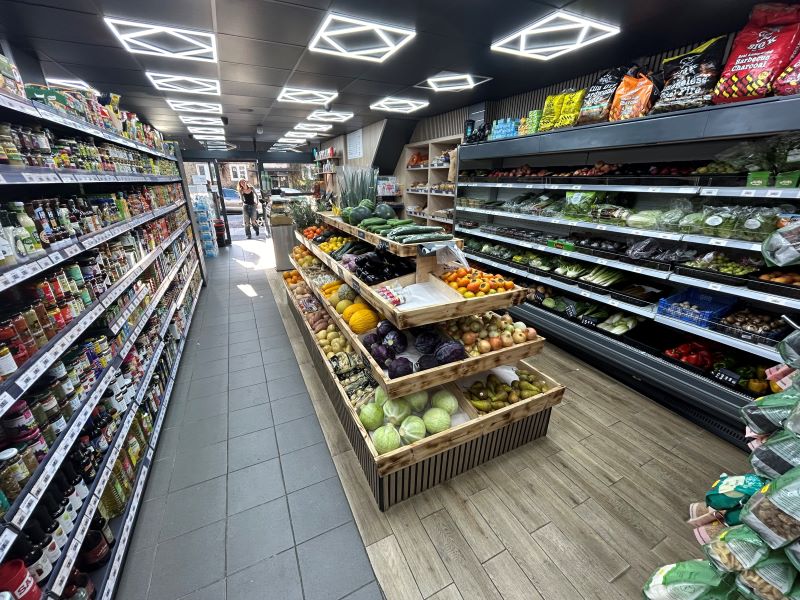
The stunning display of produce on offer at Mehmet’s VitaPure

Diversifying services has been key to staying competitive. Mehmet’s shop is not just a grocery store – they sell high-quality takeaway coffees and a range of savoury Turkish pastries, including homemade borek and flatbreads. By the entrance, they’ve even set up a booth selling Hackney Gelato. “You can do your shopping and enjoy a nice flatbread or ice cream here – why not?” Mehmet said. “It’s all about making sure people can get something different in their local shop, which they can’t get at the supermarket chains.”

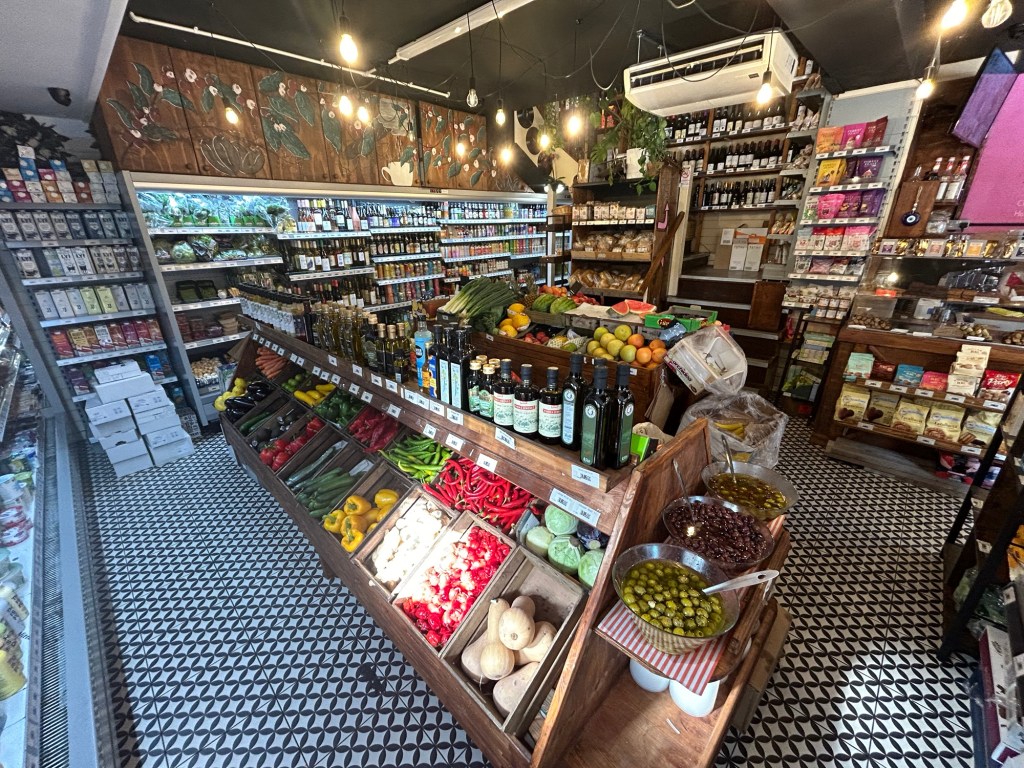
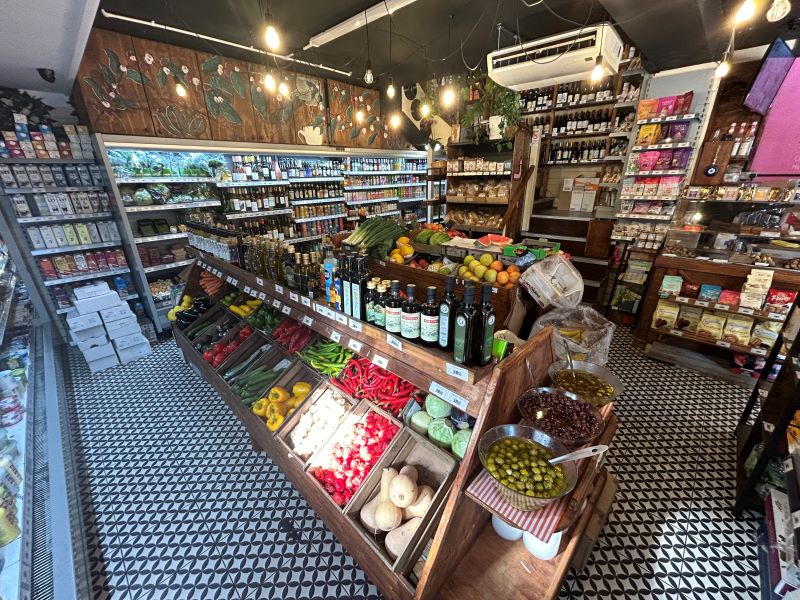
The wonderfully arranged display of offerings at Greenwood Food & Wine

One aspect that makes convenience stores such a cornerstone of British society is their ability to offer personalised, intimate customer service. For Sahin and Mehmet, this is key. “If you go to Tesco and you’re short 1p, they’re not going to let you go,” Sahin remarked, highlighting how independent retailers can offer a more flexible, human shopping experience.

Mehmet even considers his customers as friends, noting how he orders ingredients on request for his regulars. He added: “In Tesco, you’re nothing.”

While the story of East London’s independent convenience stores is one of resilience and adaptability in a changing and challenging environment, there are still doubts ahead. Sahin recently installed a small café in Greenwood Food & Wine but is already worried about what he’ll need to spend on next to stay current. Most concerning for him is the rising cost of groceries, which gives chain convenience stores, able to buy in bulk, a significant advantage. “If I bought six tonnes of olive oil two years ago and kept it, I’d be a millionaire now,” he joked, alluding to the challenges of keeping prices competitive while dealing with soaring costs.

Yet Sahin remains undeterred. “I started working in this shop at 19, now I’m 40… I’ve seen rough Hackney and now trendy Hackney.” He isn’t going anywhere, and neither are East London’s independent convenience stores, which continue to find ways to embed themselves in the fabric of their communities.